
In calculating an operating enterprise value, only the operating returns and capital would be used.The value for non-equity finance would be calculated using the financing returns and capital and the value of the non-core assets would be derived from the non-core returns and capital. What is crucially important is that the correct returns and capital items are used in each part of a valuation, e.g. returns from non-core assets should not be used to calculate the value of operating assets, etc.
When producing a valuation therefore, the elements of a company’s returns and capital must be broken down into three key areas:
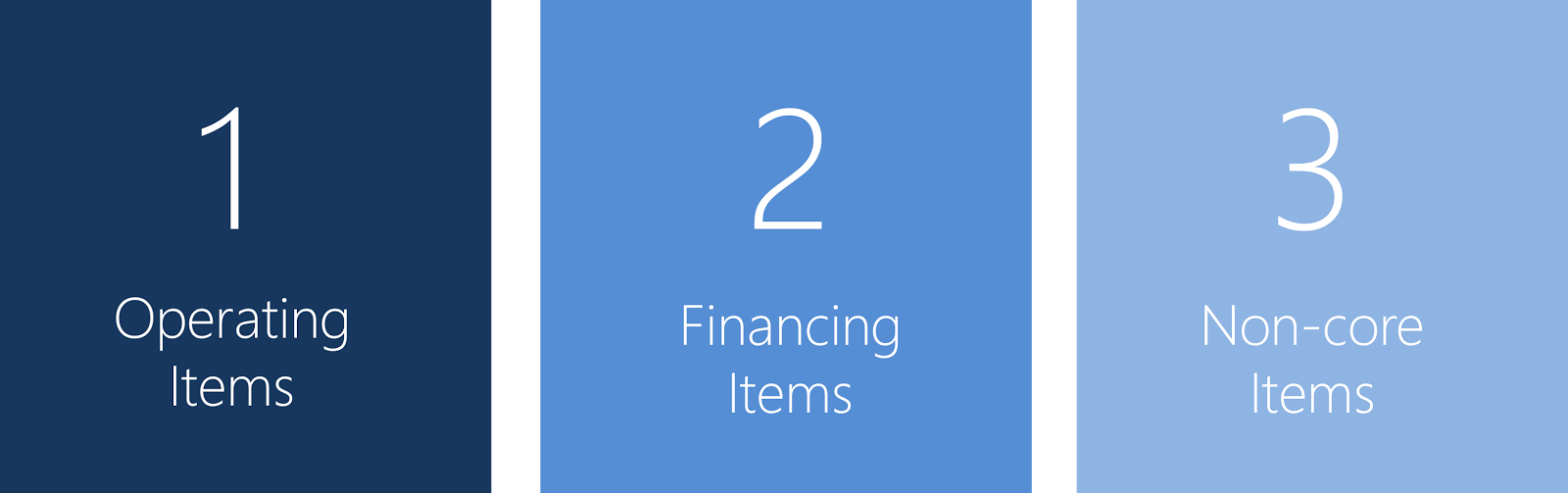
A calculation of enterprise and equity values will start by analysing the operating and financial items in a set of accounts. Operating items relate to enterprise value, the value of the entirety of the operations of the business, while financing items are deducted from enterprise value to get to equity value. Non-core items are extracted from the accounts and valued separately. As discussed, an example of non-core items would be Nestlé’s investment in L’Oréal, which is a non-core investment (food vs. cosmetics).
Operating Items
Within a set of accounts, operating items in the income statement include EBIT (earnings before interest and tax) and any items above EBIT (profit before interest, which is paid away to non-equity financiers). In the cash flow statement, the operating items are detailed in cash flow from operations (again before financing payments/receipts) and in the balance sheet, operating items are the net operating assets of the company.

Looking in a bit more detail, this means the return items that are operating items include revenue, EBITDA (Earnings Before Interest, Tax, Depreciation and Amortisation) and EBIT, and the capital items include operating assets such as fixed and intangible assets and working capital (current assets less current liabilities).

Financing Items
In a set of accounts, financing items in the income statement include items such as interest in the income statement (to get to profit after interest, which is available to equity holders), cash flow from financing and investment in the cash flow statement and non-equity finance in the balance sheet.
This means financing items will include interest payable and receivable and other financial
income/expense from the income statement. These would be deducted from operating returns to get to equity returns. In the balance sheet, financing items include net financial debt, provisions and minority interests.
Financing items in total make up non-equity finance (as detailed above) and in each area would be defined as follows:

It is worth commenting at this point on the definition of net financial debt. The simplifying
assumption made above is that any cash (or marketable securities) held by a company is not required to finance the operations of the company. However, there will be occasions when a company does require cash to finance its operations, e.g. a retailer that requires a cash float for its tills or a travel company that is required to post a bond as part of its ABTA membership. If cash is identified that is not surplus but an integral part of the operations of the company, then it should not be deducted from financial debt but instead included in working capital as part of the operational assets of the company.
Non-core Assets and Liabilities
Non-operating or non-core items relate to unusual items or investments that the company has made that are not part of the underlying operations of the business. They include assets that are no longer part of the business (discontinued operations, disposed assets) or investments that do not relate to the company’s ongoing operations, e.g. Nestlé’s investment in L’Oréal.
In the accounts of a company, non-core assets relate to anything that is not part of the underlying returns or capital of the company. In the income statement, this would generally include restructuring charges (unless recurring), impairments and profits/losses on disposal of assets/businesses. Disposal profits or losses may be operational for some types of company, e.g. for a car rental business (constantly turning over its vehicle fleet). Under IFRS, assets and liabilities held for sale are separated out in the balance sheet, so these are specifically identified as being non-core. For the purpose of this manual, it is assumed that associates (or any investment that is not consolidated) are non-core. Investments in unrelated businesses are always non-core and joint ventures are generally treated as non core, unless the joint venture is proportionately consolidated.
The main problem with non-operating or non-core items is the amount of judgement that has to be applied to decide what is non-core, which can be difficult to determine. The key issue is consistency. If, for example, associates are treated as core, then any associate income would be included in operating returns and the value of the associate would be included in operating capital.
Key learning points:
- Returns and capital can be broken down into operating, financing and noncore items.
- Operating items relate to enterprise value and include returns such as EBITDA and capital.
- Financing items relate to non-equity finance and if deducted from operating items, produce equity returns or capital.
- Non-core items do not relate to the core activities of the business and should be extracted.


